
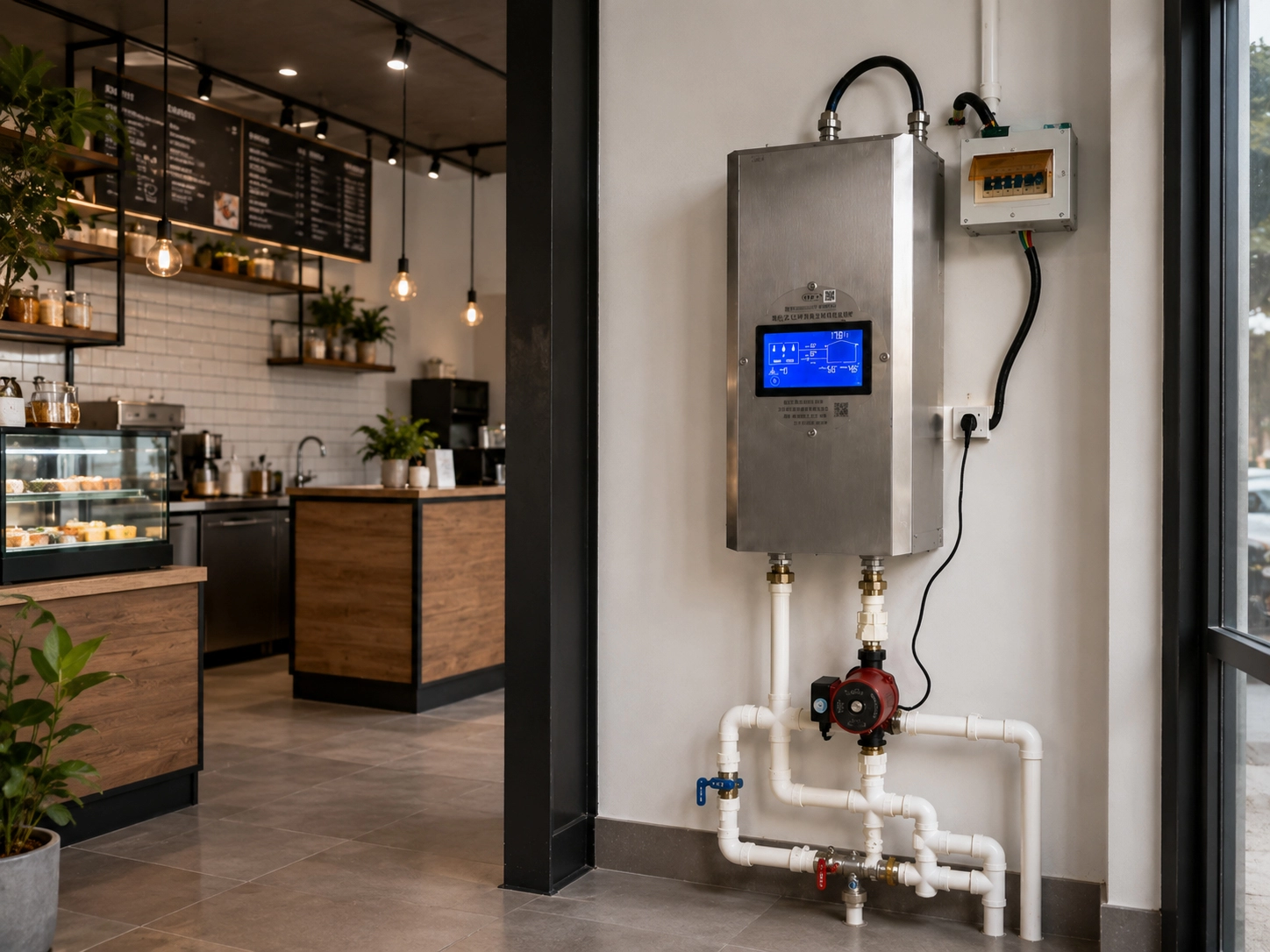
Quick answer: Two numbers matter most in an electric heating system and neither is the headline efficiency figure. Thermal storage capacity determines how long the system can carry a building through a cold night or a peak-tariff window, and controller architecture determines whether the system actually uses cheap electricity or merely claims to. Efficiency percentages above roughly 95% tell you very little about real running cost, because resistive heating is inherently near-100% efficient and the differences lie in how heat is stored and when it is produced.
Why the efficiency figure cannot differentiate electric heating systems
Resistive electric heating converts essentially all the electricity it consumes into heat. That is physics, not engineering achievement, and it means every electric boiler on the market is around 99% efficient at the point of conversion. A catalogue comparing one brand's "99% thermal efficiency" against another's "98%" is comparing measurement noise.
What actually separates systems is when the electricity is consumed relative to the tariff, and how much of the heat produced can be held until it is needed. A system that runs at 3 a.m. on off-peak power and releases heat at 7 a.m. delivers the same comfort at a materially lower cost than one that runs at 7 a.m. on peak power. That difference can dwarf any plausible variation in conversion efficiency.
This is why thermal storage and control architecture deserve more attention in a specification than the efficiency number, and why they are the two areas where manufacturers genuinely differ.
Thermal storage: three approaches and what each is good at
Storage in an electric heating system takes one of three general forms. They are not interchangeable; each suits a different operating pattern and building type.
| Storage approach | How it works | Best suited to | Main limitation |
|---|---|---|---|
| Water buffer tank | Heats a volume of water during cheap hours; circulates it later | Hydronic systems serving radiators or underfloor loops; retrofit projects | Bulky; heat loss from the tank itself is continuous |
| Phase-change material (PCM) | Stores latent heat in a medium that changes phase near the working temperature | Compact installations where space is the binding constraint; high-density storage | Higher material cost; storage capacity degrades if the phase-change cycle is not respected |
| High-temperature solid mass | Heats a dense solid core and releases it slowly over hours | Long discharge periods; buildings with steady overnight demand | Slower to charge; requires careful insulation of the core |
The right question is not "which storage type is best" but "how many hours of heat does this building need to hold, and what space is available to hold it in". A small apartment with a few hours of overnight setback has different requirements from an agricultural building that must stay above freezing through a long cold night.
Controller architecture and what it does to running cost
An IoT-enabled controller is often presented as a convenience feature — remote temperature adjustment from a phone. Its more significant function is deciding when the system charges storage based on tariff, forecast and occupancy. That decision is where the running cost is set.
Three functions matter in practice. First, schedule programming by tariff window, so the system preferentially produces heat when electricity is cheapest. Second, weather compensation or forecast awareness, so storage is charged in proportion to the actual expected load rather than to a fixed schedule. Third, power level management, so the system can draw from renewable generation when it is available and step down when it is not.
The practical test of any controller is straightforward: can it demonstrate what the system did and why? A controller that logs running hours, power draw and storage state lets you verify that the off-peak strategy is functioning. One that offers only a current temperature reading and a mode selector gives you nothing to check against.
Renewable integration changes the control problem
When a system can draw on photovoltaic, wind, solar thermal or waste heat, the controller's job becomes more complex and more valuable. The objective shifts from "use the cheapest tariff window" to "use available renewable energy first, then top up from the grid at the cheapest time".
This ordering matters because renewable output is intermittent and often coincides with periods of lower heat demand. Without storage, surplus midday photovoltaic output is exported rather than used; with storage sized appropriately, it can be banked and released in the evening. The coordination function is what converts a set of energy sources into an operating cost advantage, and it is the reason a system's integration capability should be evaluated together with its storage capacity rather than separately.
Systems that can accept multiple inputs — grid, photovoltaic, wind, solar thermal, waste heat and off-peak electricity — are more valuable in projects where energy supply is mixed or where supply arrangements may change over the equipment's service life. Specifying for the current energy configuration alone can leave a building locked into an expensive arrangement for a decade or more.
Four specifications worth requesting
- Usable storage capacity in kWh, with the discharge profile. Nameplate capacity is less useful than the heat actually available over a realistic draw-off period.
- Controller logging capability. What is recorded, for how long, and whether it is exportable. This is what lets you verify the off-peak strategy is working.
- Supported energy inputs and the switching logic between them. Which sources can be connected, and how the controller prioritises them.
- Power level steps available. Whether the unit can modulate or step between power tiers, which determines both supply compatibility and renewable utilisation.
Frequently asked questions
If all electric boilers are about 99% efficient, why do running costs differ so much between models?
Because efficiency at the point of conversion is not where the money goes. Running cost is driven mainly by when electricity is drawn relative to the tariff and how much heat can be stored between cheap and expensive periods. A system with significant storage and tariff-aware control can shift most of its consumption into off-peak hours. A system without storage has to produce heat when the building needs it, regardless of price. Over a heating season that timing difference typically outweighs any small efficiency variation.
Is phase-change storage better than a water buffer tank?
Not universally. Phase-change materials store more heat per unit of volume, which makes them attractive where floor space is genuinely constrained. Water buffer tanks are simpler, generally cheaper, and well understood by installers. If space is not the binding constraint, a conventional buffer tank is often the more practical choice; if it is, phase-change storage earns its higher material cost.
How much storage capacity does a house actually need?
Enough to bridge the gap between the cheapest charging window and the period of highest demand. If off-peak electricity is available for eight hours overnight and the building needs heat through a further four hours in the morning, the storage has to cover roughly those four hours at the prevailing heat load. That is a calculation, not a rule of thumb — the required capacity scales directly with the building's heat load and the length of the bridging period.
Can a heating system really run on solar and wind power alone?
For most buildings, no — renewable sources are intermittent and heating demand peaks when solar output is lowest. The realistic configuration is hybrid: the system draws on renewables when available and falls back to grid electricity, ideally during off-peak hours, when they are not. The controller's energy prioritisation is what makes this arrangement cost-effective rather than merely nominal.
What should I check about an IoT controller before buying?
Check whether it logs operating data and whether that data can be exported. Remote temperature control is convenient but does not by itself reduce cost. The cost reduction comes from tariff-aware scheduling, and verifying that scheduling works requires a record of when the system ran and how much power it drew. Without logging, you cannot tell whether the off-peak strategy is functioning as intended.
Specifying a heating system for a project? Share your heat load, available tariff structure, renewable energy sources and the number of hours the building needs to bridge without grid input. Our engineering team will recommend a storage and control configuration matched to how the building will actually operate.